

Law firms and AI: what artificial intelligence makes more valuable
- By Connection Leadership
- 8 min read
Contents
Share
Artificial intelligence is accelerating the production of law: 93% of French lawyers use it in their work. It shifts the value of law firms toward three areas: relationship capital, the ability to create a human outcome for the client, and the training of a generation that works with AI. Connection Leadership, a transformation consulting firm, draws these insights from assignments with a law firm, an international network of law firms and a notarial firm, in France, New York, Munich and Prague.
Key takeaways
93 %
of French lawyers use AI in their work (CNB/Ifop 2026)
6 %
of in-house lawyers say most of their firms deliver the gains they expect from AI (Thomson Reuters)
23 %
of young French lawyers see themselves following the classic path to partnership (CNB/ViaVoice)
From case to relationship: trust and referrals drive the client’s choice. From solution to outcome: counsel creates the conditions for a decision everyone can stand behind. Training differently: firms are inventing a new form of apprenticeship.

Artificial intelligence is now at home in law firms. According to the 2026 CNB/Ifop barometer, 93% of French lawyers use it in their work, 70% of them several times a week, and 88% believe it will profoundly transform their profession. Research, synthesis, the first draft of a deed: what once took entire days now takes a few minutes.
Such a shift invites a more fruitful question than survival: what becomes of a firm when the production of law accelerates to this extent? Our conviction is that AI shifts value toward what has always made the profession great: trust, relationships, judgment, transmission. Three shifts are already taking shape. Each opens room for growth for the firms that choose to seize it.
01
From case to relationship: relationship capital becomes the strategic asset
When legal technique becomes accessible to all, the choice of counsel rests on something else: trust, reputation, a peer’s recommendation. Clients themselves are changing their stance. According to Thomson Reuters’ Future of Professionals Report 2026, 70% of in-house lawyers expect productivity gains from AI from their outside counsel, and only 6% say most of their firms deliver them. Nearly a third say they are re-examining their relationship with firms that are slow to demonstrate this value within the year. An ACC/Everlaw survey adds that 64% of legal departments plan to bring more work in-house.
In France, the CNB/Ifop barometer paints the same picture: 57% of lawyers report difficulties growing their practice, 62% feel in competition with non-legal professions, and business development has become a priority for 67% of them.
Business development is now revealed for what it is, an art of relationships: knowing clients’ sectors intimately, cultivating a circle of referrers, circulating matters between partners, fully inhabiting the networks the firm belongs to. A firm’s roots in its ecosystem become its first asset, the one only it can build.
This shift is deeply collective: 68% of lawyers believe the future of the profession lies in more collective structures. The partner’s personal book of business gives way to a shared culture, in which everyone, from junior associate to founding partner, knows they carry the firm’s relationships and reputation.

02
From solution to outcome: the relationship as the place where value lies
A legal solution answers a question. A client, however, arrives with a situation: the transfer of a family business, a dispute between partners, a reorganization affecting hundreds of lives. What they hope for goes beyond the legally correct answer.
The human outcome sought is what the client expects beyond the legal answer: a preserved relationship, calmer governance, a decision everyone can stand behind.
Connection Leadership
AI excels at producing answers. Creating the conditions for an outcome belongs to those who know how to listen, question, hold tension around a table and guide a difficult decision. Ronald Heifetz distinguishes technical problems, which expertise alone can solve, from adaptive challenges, which require the people involved to change themselves. The former are migrating to the machine. The latter are becoming the heart of the advisory profession.
Clients are ready for this. The study conducted by ViaVoice for the CNB observes that they arrive better prepared, having obtained a first level of answer from AI. The meeting then changes in nature: it begins where information ends, on discernment and choice. The CNB/Ifop barometer also sends a signal worth hearing: lawyers’ satisfaction with the quality of their client relationships, still high at 89%, has fallen by five points.
The business model will follow this shift. According to Thomson Reuters, nearly two-thirds of law firm professionals say their pricing structure has remained unchanged, while their clients expect fees that reflect AI-driven gains. Billing for an outcome rather than time spent requires the ability to name that outcome with the client, from the very first conversation. It is a relational skill before it is a financial one.
03
Working with AI, training differently, welcoming new generations
AI is settling into firms as a colleague to be supervised. The CNB barometer on AI use, conducted among 2,281 lawyers, shows that 58% delegate at least one task to it, most often a first version that is then reviewed and reworked. Fully autonomous delegation remains below 3%. Judgment remains human, and 84% of users cite time savings as the main benefit.
The whole question is what the firm will do with this time regained. Lawyers give the answer themselves in their training needs: mastering AI tools comes first (90%), while management (66%, up seven points) and innovation (61%, up ten points) are rising sharply. The profession senses that technology calls for more human skills.
Training the youngest is the most delicate task. An associate used to learn the job through the research, memos and first drafts that AI now handles. It is up to firms to invent a new form of apprenticeship: exposing juniors to clients earlier, teaching them to supervise the machine, to question its answers, to exercise their judgment, and offering them regular feedback on their practice.
These new generations arrive with their own expectations. 81% of lawyers under 35 regularly use AI. Nearly a quarter of law firm professionals surveyed by Thomson Reuters would turn down a job offer lacking professional-grade AI tools. A 2024 CNB/ViaVoice study, reported by Justifit, finds that only 23% of young lawyers see themselves following the classic path from associate to partner. They are looking for meaning, flexibility and continuous learning.
Firms that know how to welcome them will gain a double transmission: the technological ease of the youngest enriches the partners’ practice, and the partners’ experience shapes the judgment of the youngest.
04
What we learn working alongside firms
At Connection Leadership, our work with legal players is organized around an offering dedicated to law firms and legal networks: Law Leadership, designed to address their economic, technological and human transformations. It follows the three phases of The Catalyst Experience: reveal the system, set it in motion, anchor the transformation. Three experiences shed light on the shifts described here.
International network · Governance
An international network of law firms: renewing governance
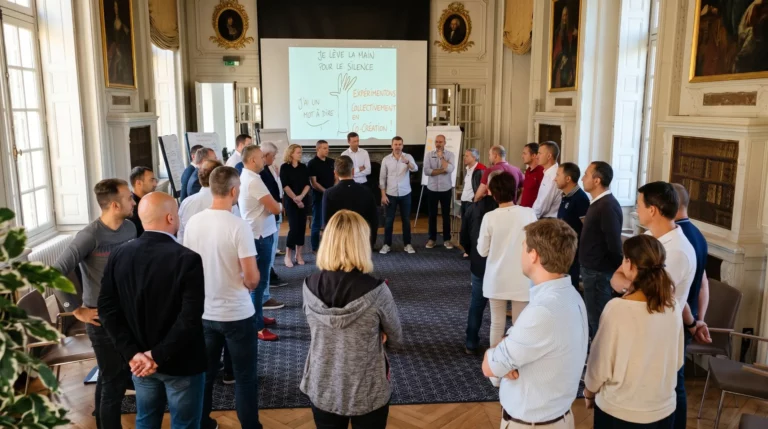
With an international network of full-service law firms, we worked on renewing governance after the departure of founding members. Three strategy seminars, in New York in the spring, in Munich in the winter and in Prague, worked on trust, shared leadership and ownership of projects. A nine-month program then energized marketing and business development, the onboarding of new members and cross-referrals between firms. The network rediscovered what gives it its purpose: living relationships. During the assignment, it welcomed two new firms, one in Turkey and one in Brazil, both recruited through contacts within the network.
Law firm · Partner alignment
A law firm: aligning the partners and structuring development
With a law firm seeking to structure its development and align its partners, the assignment unfolded in three stages, which match the three phases of our approach.
Reveal: a diagnostic based on individual interviews and a kick-off seminar, “Past, present, future”, created a united team dynamic.
Set in motion: the vision, purpose and values were defined together, through peer-coaching workshops and collective coaching.
Anchor: brand positioning, management training, process optimization and digitalization established the firm’s autonomy. At the final review, all respondents said the purpose had been communicated and that the team had made it their own.
100 %
of respondents considered the firm’s purpose well defined at the final review, compared with 14% at the start
Notarial firm · Strategy and management
A notarial firm: clarifying strategy and developing management skills
With a notarial firm, the work focused on clarifying strategic issues, internal organization and developing the management and entrepreneurial skills of partners and staff alike.

A team that knows the profession from the inside. Connection Leadership brings together former lawyers who have become coaches and consultants, such as Alexis Desouches, a former lawyer and mediator, alongside consultants who have held general management, finance or HR leadership roles. This dual culture offers an intimate understanding of the realities of the profession: mental load, governance between partners, retaining young talent, client relationships. It draws on a collective with complementary expertise, from strategy to AI, from coaching to facilitation, and on an approach that holds together the rigor of transformation and the depth of human work.
05
New opportunities are taking shape
Lawyers are approaching this moment with clear eyes. According to the 2026 CNB/Ifop barometer, a third of them are considering leaving the profession, and yet 92% say they are proud to practice it. This pride is an immense resource. It says that the profession keeps its full meaning, and that it is up to firms to give it a new form.
AI frees up time. Firms that invest it in their relationships, in the quality of their presence with clients and in the growth of their teams will turn this transformation into an opportunity. Law has always been a matter of trust between people. Our times invite us to make it, more than ever, the heart of our practice.
At Connection Leadership, we create the spaces for dialogue and alignment where a vision becomes shared priorities, priorities become commitments, and commitments become results. To take the reflection on the role of advisors further, read À quoi servent les consultants ? (What are consultants for?) by Betsy Parayil, or get in touch with our team.
And in your firm, where will AI unlock the most value?
Law Leadership
Three steps from intention to action plan
Step 1
An initial conversation to define your needs
Step 2
A diagnostic
Step 3
An action plan shared with leadership
Human and business alignment that unlocks business results.
Connection Leadership
06
Frequently asked questions
How many lawyers use AI in France?
According to the 2026 CNB/Ifop barometer, 93% of French lawyers use artificial intelligence in their work, 70% of them several times a week. Among lawyers under 35, 81% use it regularly.
Will AI replace lawyers?
AI takes over technical tasks such as research, synthesis and first drafts. Fully autonomous delegation remains below 3% (CNB barometer on AI use). Value shifts toward relationships, judgment and guiding difficult decisions, which clients continue to expect from their lawyer.
What is the “human outcome sought”?
It is what the client expects beyond the legally correct answer: a preserved relationship, calmer governance, a decision everyone can stand behind. Connection Leadership uses this notion to help firms define their value and bill for an outcome rather than time spent.
How should young lawyers be trained in the age of AI?
Firms are inventing a new form of apprenticeship: exposing juniors to clients earlier, teaching them to supervise AI and question its answers, to exercise their judgment, and offering them regular feedback on their practice.
What does Connection Leadership offer law firms?
Connection Leadership, a transformation consulting firm, offers Law Leadership, a program dedicated to law firms, legal networks and notarial firms: governance between partners, vision and purpose, business development, management training. Its team brings together former lawyers and former executives, and has conducted assignments in France, New York, Munich and Prague.
Sources
1. CNB/Ifop 2026 barometer “State of the profession”, 4,740 lawyers surveyed in May 2026, Le Monde du Droit (in French)
2. Barometer of AI use in the legal profession, 2,281 lawyers surveyed in September 2026, Conseil national des barreaux (in French)
3. Future of Professionals Report 2026: Actionable insights for law firm leaders, Thomson Reuters Institute
4. ACC/Everlaw survey on generative AI and legal departments, October 2025, Bloomberg Law
5. Generative artificial intelligence and the legal profession, ViaVoice study for the CNB, June 2025 (in French)
6. How legal careers are evolving in law firms, Justifit, citing CNB/ViaVoice 2024 (in French)

Connection Leadership
A transformation consulting firm, Connection Leadership brings together former executives and former lawyers around one conviction: human and business alignment unlocks business results.
Your inflection point is the moment we’re built for.
The Catalyst Experience is systemic transformation that combines business precision and human potential to turn ambition into results.