
Responsible communication: a strategic lever for businesses
- By Connection Leadership
- Updated on 21 November 2026
- 10 min read
Contents
Share
Responsible communication aligns what a company says with what it does: proven commitments, sober messages and narratives that make sustainable practices desirable. Since 27 September 2026, the EU directive 2024/825, known as “EmpCo”, has strictly regulated environmental claims. Responsible communication has therefore become a compliance requirement as much as a lever for trust and differentiation. This article sets out the 6R model, the four controversies running through the profession and the three pillars of a credible approach.
Key takeaways
73 %
of people surveyed believe brands must act now for the good of society and the planet (Havas, 2023)
53 %
of the environmental claims examined by the European Commission were vague, misleading or unfounded
6 R
levers to transform communication for the ecological transition
Since 27 September 2026: the EmpCo directive regulates environmental claims across the European Union. Key points: the 6R model, four controversies, three pillars of credible communication.
01
Why responsible communication is becoming a strategic priority
Corporate communication is entering a new era. Customers, employees and investors expect brands to make commitments that are concrete, measurable and consistent with their practices. According to the Havas Meaningful Brands 2023 study, 73% of people surveyed believe brands must act now for the good of society and the planet, and consider communication alone insufficient1.
This expectation meets entrenched distrust: a European Commission study of 150 environmental claims found that 53% of them were vague, misleading or unfounded2. Lawmakers have therefore strengthened the framework, first in France and then at European level.
2020 · AGEC law
France’s anti-waste and circular economy law bans claims such as “biodegradable” or “environmentally friendly” on products and packaging.
2023 · Climate and Resilience
Since 1 January 2023, any French advertisement presenting a product as “carbon neutral” must rely on a published emissions inventory, reduction pathway and offsetting methods3.
2026 · EmpCo directive
Applicable since 27 September 2026, directive (EU) 2024/825 bans generic environmental claims that cannot be substantiated and neutrality claims based on offsetting4.
In France, the transposition bill, adopted by the Senate on 18 February 2026, is still going through Parliament. Companies have every reason to comply now: the French Consumer Code already sanctions misleading commercial practices5. The proposed Green Claims Directive, for its part, has been on the list of texts the European Commission plans to withdraw since 4 November 20266. The reference framework is therefore consolidating around the EmpCo directive.
Beyond compliance, responsible communication creates a lasting competitive advantage: it aligns discourse, values and actions, and builds trust with all stakeholders.
02
The 6R model: six levers to transform your communication
The 6R model gives organisations an operational framework for integrating the ecological transition into their marketing and communication. It responds to the four controversies running through the profession (section 03) and translates into six levers.
R1 · Rethink
Rethink the role of the brand. Redefine the purpose beyond the transaction and align stated values with actions. Patagonia sets the example: since 2022, profits not reinvested in the business fund the fight against the climate crisis7.
R2 · Respect
Respect the living world as a whole. Broaden impact measurement beyond carbon: biodiversity, water, soil, raw materials, life-cycle assessment. Communication then relies on scientific data and transparent methods.
R3 · Reward
Reward everyone fairly. Share the value created fairly with producers, partners and customers, then make this sharing visible with clarity and transparency.
R4 · Relate
Tell the stories that make a difference. Create desire around sobriety with inspiring narratives. French brand Les Gueules Cassées turned “ugly” fruit and vegetables into a desirable category while reducing food waste.
R5 · Reduce
Reduce negative impacts. Apply eco-design to communication itself: sober digital media, optimised ad formats, measured events, suppliers chosen on responsible criteria.
R6 · Rally
Rally people to new ways of living. Make deliberate choices of channels, formats and products consistent with your commitments. These trade-offs become markers of conviction that strengthen the company’s credibility.
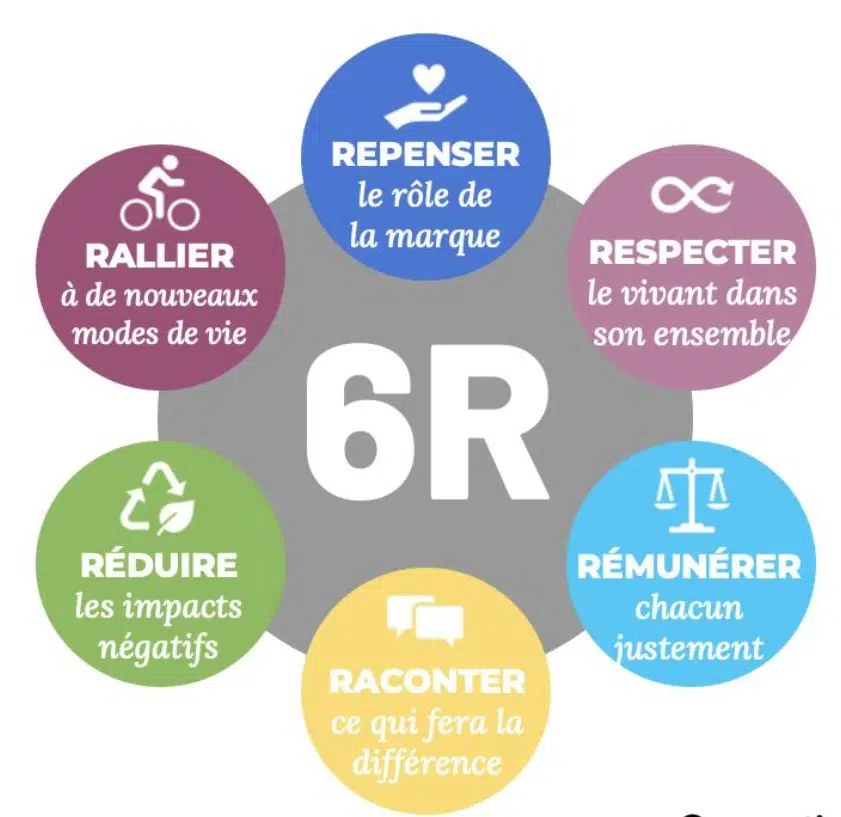
Each lever requires marketing and communication teams to build new skills. The most advanced companies formalise these six dimensions in an eco-communication charter that links the message to the way it is delivered.
03
The four controversies running through communication
Four questions frame today’s debate on the role of communication in the ecological transition. Understanding them helps build an approach that lives up to public expectations.
Controversy 1 · Imaginaries
The impact on collective imaginaries
Communication shapes our representations of happiness, success and achievement. It helps build social and cultural norms, and can therefore establish new ones.
Controversy 2 · Information
Compatibility with freedom of information
How can effectiveness be reconciled with respect for citizen-consumers’ independent judgement? The line between persuasion and manipulation becomes a governance issue.
Controversy 3 · Consumption
Encouraging overconsumption
Communication can drive consumption that exceeds planetary boundaries. The challenge is to promote sobriety and business models that fit within those boundaries.
Controversy 4 · Ethics
Ethics and self-regulation
Which ethical frameworks should apply when practices move faster than regulation? The sincerity of commitments becomes the condition for trust.
These controversies explain public distrust of corporate communication. They also make it a field of transformation for organisations that choose consistency.
Our webinar on responsible communication (in French)
04
The three pillars of credible communication
In this context, responsible communication rests on three inseparable foundations.
1. Expert knowledge. A solid command of environmental, social and regulatory issues makes it possible to build a well-founded discourse: climate and biodiversity science, life-cycle assessment, the EmpCo directive, CSRD, climate justice. Connection Leadership observes that employees engage more when they understand these issues and connect their mission to the challenges of the transition.
2. Humility and transparency. Acknowledging limits, presenting the progress made and the road ahead, and making promises in line with one’s means: this stance becomes a powerful driver of trust.
3. Transformative creativity. Imagination makes it possible to invent new narratives, new forms of engagement and new relationship models. It reconciles economic performance with positive impact, and sobriety with desirability.
Responsible communication says what the company does, proves what it claims and makes people want to act.
Connection Leadership
05
How Connection Leadership approaches responsible communication
A transformation consulting firm, Connection Leadership brings together more than 250 senior consultants, former executives and experts who connect strategy, leadership, culture and execution. On responsible communication, we work at every level of the organisation: raising employee awareness, training marketing and communication teams, building the transition plan and coaching the leaders who drive change.
Our The Catalyst Experience approach connects business precision and human potential. To go further, read our analysis of the ecological transition in industry in 2027.
Ecological Transition Skills Diagnostic
Three steps to build the skills for your transition
Step 1
Current-state analysis: mapping the organisation’s existing skills.
Step 2
Forward-looking mapping: identifying the skills needed to reach your transition goals.
Step 3
Tailored action plan: building a skills development pathway adapted to your teams.
06
Towards a new paradigm of communication
Responsible communication marks the advent of a new paradigm. It is a strategic opportunity for companies that want to combine economic performance with a positive contribution. It demands courage, consistency and creativity, and opens new territories of expression and engagement.
Above all, it builds lasting trust with the company’s entire ecosystem: customers, employees, partners and investors. That trust is today’s most valuable capital.
At Connection Leadership, we create the spaces for dialogue and alignment where a vision becomes shared priorities, priorities become commitments, and commitments become results.
And in your organisation, what place does responsible communication hold in your strategy?
Human and business alignment that unlocks business results.
Connection Leadership
07
Frequently asked questions
What is responsible communication?
Responsible communication reduces its own environmental and social impacts throughout its life cycle and reports sincerely on the organisation’s commitments. It relies on evidence, sober messages and narratives that encourage sustainable practices.
What is the difference between responsible communication and greenwashing?
Greenwashing presents an environmental image more favourable than reality, through vague, exaggerated or unverifiable claims. Responsible communication does the opposite: every claim rests on verifiable data, concerns a specific characteristic and comes with measurable commitments.
What does the EmpCo directive change for corporate communication?
Directive (EU) 2024/825, known as EmpCo, has applied since 27 September 2026. It bans generic environmental claims such as “eco-friendly” or “green” without recognised excellent environmental performance, carbon neutrality claims based on offsetting, and sustainability labels lacking a certification scheme or public origin. In France, the transposition law is still being adopted, and the Consumer Code already sanctions misleading commercial practices.
What is the 6R model?
The 6R model offers six levers to transform marketing and communication for the ecological transition: rethink the role of the brand, respect the living world as a whole, reward everyone fairly, tell the stories that make a difference, reduce negative impacts and rally people to new ways of living.
How can an environmental claim be made credible?
A credible claim concerns a specific characteristic of the product or company, relies on measured and verifiable data, states the limits of the approach and points to detailed information available to the public. A future commitment relies on a detailed implementation plan verified by an independent third party.
What is the status of the EU Green Claims Directive?
Proposed by the European Commission in March 2023, the Green Claims Directive has been on the list of proposals the Commission plans to withdraw since 4 November 2026, published with its 2027 work programme. The EmpCo directive is therefore the European reference framework for environmental claims.
What role does Connection Leadership play in responsible communication?
Connection Leadership, a transformation consulting firm, helps companies align strategy, teams and communication with their ecological transition commitments: awareness, training for marketing and communication teams, the Ecological Transition Skills Diagnostic, transition planning and leadership coaching.
Sources
1. Havas, Meaningful Brands 2023
2. European Commission, 2020 study of 150 environmental claims, cited by KPMG Avocats (January 2026, in French)
3. French Ministry for the Ecological Transition, Fighting greenwashing in advertising (in French)
4. DGCCRF, Directive (EU) 2024/825 and the fight against greenwashing (in French)
5. CMS Francis Lefebvre, Greenwashing: awaiting the transposition of the EmpCo directive in France (October 2026, in French)
6. Lewis Silkin, The Green Claims Directive is dead (November 2026)
7. Patagonia, Earth is now our only shareholder (September 2022)
Further reading: ADEME, Responsible communication for businesses (in French)

Connection Leadership
A transformation consulting firm, Connection Leadership brings together more than 250 senior consultants, former executives and experts, around one conviction: human and business alignment unlocks business results.

Your inflection point is the moment we’re built for.
The Catalyst Experience is systemic transformation that combines business precision and human potential to turn ambition into results.